It’s been awhile since my last post and, if I have to be honest, that may be the case for the rest of my service (15 months, in case you were wondering). Things get harder to write about in the outlet of a blog. I have less original thoughts and observations about life here; the bizarre and exciting have become the mundane. And even those aspects of Beninese culture and its people that I still find surprising, hilarious, frustrating, or confusing seem unworthy of repetition here. You’ve all heard my gripes. Conversations among volunteers increasingly breach the bigger subjects- not what comprises their culture but why it is that way, not why we came here but why we stay, which are wholly different. Some of what I’d like to write here might seem insensitive or politically incorrect to you, you who know what you do of Africa from MSNBC special reports, Oxfam newsletters, and glossy coffee table books. I hate to have your opinion lowered of me before I can get back to America and do it myself.
So. It was high time for a vacation. I had gone 10 months without boarding a plane, probably the longest time in my life. Even the flight from Accra (Ghana) to Johannesburg felt luxurious. Getting from Cotonou to Accra, though, was an ordeal. We (Brigitte, the other volunteer I was traveling with) had to take a series of taxis through Togo and Ghana totaling 8 or 9 hours, at least 3 of which were on dirt roads, to reach the airport in Accra. Each country seemed to be sequentially better—cleaner, more developed, less chaotic—than the last, until arriving in South Africa felt somewhat like stepping through the wardrobe into Narnia. Or when you go to the optometrist to be fitted for glasses and the doctor flips through lenses that go from blurry to tolerable to crystal clear until there is the one that fits just right. Development is my home. Unfortunately, we didn’t look too much like we belonged: we looked pretty haggard after 30 straight hours of travel, our red dirt-caked clothes and faces characteristic of life in West Africa not fitting in to the June winter of South Africa.
Our two-week vacation was spent half in Cape Town and half in Johannesburg. Cape Town is a stunning city sandwiched between the iconic Table Mountain and the picturesque coastline. Even in a country of extraordinary history and a true melting pot of cultures, Cape Town is a gem. It has the eclectic architecture of a city that has seen influence and rule by several different European powers before adopting its own character and style. In some areas, vacant buildings and open fields stand as a tribute to the black tenants once forcibly removed from their homes during the reign of Apartheid. Murals dot the landscape and the rocky crevices of Table Mountain serves as a constant background.
Day one of our vacation was spent marveling at things like sidewalks, marked road lanes, cold weather, and shopping malls; relearning how to use eyeliner and straightening irons; and buying weather appropriate clothes to replace the rags that pass as our clothing in Benin. Cape Town was a blur of omelet breakfasts, sushi dinners, vanilla lattes, shared oogles at the posh and polished South African women, and sightseeing.
Just off the coast of Cape Town, near where the joining of the Indian and Atlantic Oceans causes some of the most dangerous currents in the world, is Robben Island on which Nelson Mandela was imprisoned. The tour of the island and prison blocks was given be an ex-political prisoner, in our case one who was held up until 1994, when the prison was shut down and all its prisoners released. We saw the cell where Nelson Mandela slept every night for almost 20 years, the court where revolutionary minds that would greatly shape the new South Africa came together, and the spot where Mandela hid the manuscript of Long Walk to Freedom before another prisoner in transport was able to smuggle it off the island (Mandela would later name that man his Minister of Transport). One day was spent climbing Table Mountain, a hike that starts off in direct sunlight at the foot of the mountain and ends in biting cold, mist, and fog at the top. We made the estimated 2 ½ hour hike in just over and hour, thawed our bones with hot chocolate at the top of the mountain, and took a cable car down.
The week spent in Cape Town was prior to the start of the World Cup so we were able to see the steady stream of fans of all nationalities flood South Africa streets and bars, donning the colors of their flags and, more likely than not, a vuvuzela, the long thin horn that is fan favorite there. They may be the only thing I don’t miss about South Africa, but then again if I had to pick between the mind-numbing buzz of a thousand vuvuzelas and the ruckus of Benin—bleating goats, moto traffic, and screams of “yovo! yovo!”—I’d choose the former.
Even those whose national teams did not make the Cup came. We met a lot of Irish who claimed they were there to cheer for whoever was playing France. South American team pride dominated the crowds, even though there were more Americans there than any other nationality, about 150,000. I have a theory that Americans were lower key and less patriotic because if you paint your face, wear your flag as a cape, and sing your national anthem obnoxiously loud in enclosed public spaces and you’re American, you’re a jerk. If you’re, say, Ghanaian or Slovak or Uruguayan, you’re just patriotic.
The second week of our trip was spent in the Johannesburg area. Though Brigitte and I had made reservations at a hostel, long story short, they did not work out and we were left opening day of the World Cup scrambling for a place to stay. Thankfully we were put in touch with a friend of Brigitte’s family friends who made our trip nothing short of perfect. I saw two games—USA v. England and New Zealand v. Slovakia—but we more or less followed all the games, which were conveniently at 1:30pm, 4:00pm, and 8:30pm daily: lunch, happy hour, and dinner. We thought we ate well in Cape Town, little did we know the wonders Johannesburg would hold. Our host Tim has a knack for finding the best of the best so in a week’s span we had the best mojitos, pasta, hamburgers, fries, strawberry daquiris, lattes, and braai (South African barbeque) South Africa--if not all of Africa--has to offer. Not to mention a fair share of wine. The week was a pretty perfect blend of boisterous crowds and electric atmospheres, and calm nights of good wine and good conversation. The last two days we spent at Tim’s house in the bush. Imagine a golf course, clubhouse, and spa in the middle of a safari park (removed of large carnivores) and houses dotting the landscape shared with warthogs, giraffes, zebras, antelope, ostriches, and exotic birds. You’ll have to see the pictures. It was the kind of thing that was too awesome for words—seeing wildlife from the window of your bath in the morning and hearing the calls of different animals while barbequing at night.
South Africa is more than interesting; it’s an anomaly within the African continent. The wealth and development, as far as I can tell, are centered around at most twenty cities, and apart from them the expansive savannah is dotted mostly by wildlife reserves, shantytowns, mining towns, and villages. Each city feels like an oasis of sorts, and traveling between them is making the switch from developed world to developing and back in a matter of hours. The South Africans we met were friendly and incredibly hospitable. I can’t say I would’ve enjoyed my trip as much had I come straight from the land o’ plenty, but coming from Benin, it was like the Emerald City.
Leaving South Africa was… is devastating too strong a word? Suffice it to say I almost missed the flight buying wine in duty free and we took full advantage of the free alcohol on the flight back to Accra (where we would have to sleep in the airport till daybreak and then start the hellish 9 hour journey back to Benin). Thankfully before leaving we stocked up on creature comforts like Doritos and crunchy peanut butter to ease the transition back to life in village. Also thankfully we made it from Accra to Cotonou when we did; riots in the capital of Togo have caused it to be declared too dangerous for PCVs to travel within the country, so other Benin PCVs currently on vacation in South Africa will have to stay in Ghana until Togo is declared safe to traverse.
And so here I am now, lucky to hear about the score of a World Cup game or see snippets on a small fuzzy TV screen, sweating out half my weight in water a day, and eating food that may change in color but rarely in texture, consistency, or taste. The kind of food that looks the same coming up as it does going down, if you know what I mean. It’s good to be back.
Sunday, June 27, 2010

Thursday, May 6, 2010
"La dote"
Among other practices, like using a typewriter and hunting your own food, the giving of dowries (la dote, in French) still occurs in West Africa. I suppose though, that dowries exist in some sense in our culture. We have retained the practice of a father walking his daughter down the aisle, symbolically giving her away (well, her and several thousands dollars spent on fancy invitations, useless favors, one-time-only dresses and tuxes, and countless yards of toole to be fashioned into large bows on the backs of chairs). Back to the topic. So, the specifics of the dowry depend on your region and local culture (yes, in a country the size of Pennsylvania there are numerous cultures and actually big differences between some of them). In Zè, before the male’s family pays dowry to his future bride and her family, he must first give her a list of what he plans to give her. A sort of starting negotiation, if you will. She then takes the proposal to her paternal aunts and revises it as they see fit, which I’m sure means supplementing it. A typical dowry may look something like this:
Father of the bride: 12 meters of fabric, 3 bottles of alcohol, cash
Mother of the bride: 6 meters of fabrics, a jewelry set, dishes
And so on, with a different combination of food, alcohol, and other gifts for each of the bride’s sisters, brothers, and aunts. In some cases, the dowry is given at a ceremony called “la connaissance.” This is somewhat like a combination engagement party/bridal shower in that its purpose is for family and friends of the bride and of the groom to meet each other as well as for the bride to receive guests and all present play stupid games. The ceremony is traditionally held at the bride’s father’s house, and she is not considered betrothed until all the gifts have been bought, presented, and, finally, accepted by the bride and her family. If a woman’s family finds the gifts to be insufficient, they may refuse to give their permission/blessing. The groom’s female relatives form a caravan in their matching fabrics with the dowry gifts atop their heads. Upon entering, they set the dowry at the feet of the bride’s relatives, take their hands, and ask them to receive the gifts.
In one game, several women’s faces are covered and they walk into a circle of the groom’s family who has to say whether or not it is their future daughter. It’s symbolic of how well they know her spirit. The other game involves kola nuts and a maternal aunt. She must throw four kola nuts on the ground until the way in which they fall indicates their ancestors’ acceptance of the marriage. Many times, there are relatives actually buried under that very floor. The succession of kola nut throws is a type of dialogue, each throw an attempt to appeal to their ancestors on the couple’s behalf. American men have it easy; if they’re old-fashioned they may ask for the blessing of her father, but they certainly don’t have to get the permission of all her dead and living relatives.
Another odd thing, is that if you are marrying a twin, the dowry ceremony is conducted as though you are marrying the both of them, which can be awkward in the case of fraternal twins, like the ceremony I saw. If the groom’s family cannot afford the dowry it is up to the bride’s father to state the terms of an alternate dowry.
I guess when reduced to its basic facts, the process is less different form ours than one might think: where they argue the length of fabric and volume of moonshine here, we might bargain for a bigger diamond or higher clarity. I suppose if I explained the bachelor/bachelorette party to Beninese, they would find it just as bizarre.
Saturday, April 24, 2010
True Life: I'm a Peace Corps Volunteer
So I rarely write about the actual volunteer side of my life here. Many of the projects I’ve attempted or ideas I’ve had have crashed and burned in a big way: starting a tree nursery, planting a garden at the orphanage, giving lessons the environment at schools all have not worked out. My host structure here is the mayor’s office, which means that they pay my rent ($11 a month) and are invited to Peace Corps training sessions with me. My official work partner is the mayor’s wife and she is in charge of environmental concerns in Zè. It’s no secret that she holds that position solely because she bore the mayor three sons (the other two wives gave him worthless daughters and got nothing as far as I can see). So I have a work partner that cares very little about the environment and knows even less. Thankfully in the same office (when I say office I mean 10 foot by 5 foot room crammed with three desks and multiple wooden filing cabinets, a fire waiting to happen) is someone else who actually knows things about the environment, Kadja Codjo. Not my official work partner but the person I work with most. I was just recently given a desk there which you would think would make me happy but instead has forced me to spend countless hours tied to that desk staring into space or, if I’m feeling shameless, doing sudoku. I go there every day, just for a few hours if I can. The projects I have with the mayor’s office are: - Monthly public lectures given in a different village on a different environmental/health topic each month. We meet in the village center and spend a couple hours cleaning up the public space before sitting down and discussing the topic. - A project for planting and upkeep of trees and public spaces in three of the lesser funded villages in the area. This project is part of a competition for environmental projects that an American group, Millennium Challenge Account, is having. People work in each of the three villages the last Saturday of the month and at the end of the year if we are chosen as one of the winning projects we get rakes, wheelbarrows, gloves, etc. - Eventually I’m supposed to help design a rudimentary waste management system but insofar as no one seems to care about helping me it’s slow going. Trash cans should probably be the first step but they jumped the gun and have a tractor, wagon, and tractor driver (who refuses to actually touch the trash) already. So now it’s the collecting of trash and loading/unloading it into/from the tractor wagon that is the problem. - Tree Day is June 1 so I hope to do something that day, however I have been told in no uncertain terms that the choice of where, when, and what to plant is solely up to the mayor, and I am foolish in thinking he has better things to do than plan this. Yet when June 1 rolls around and no one has anything planned I expect everyone to be lamenting the worthless yovo they have. My activities outside of the mayor’s office: - I have an English club every Wednesday night with the high school seniors to help them prepare for the English part of their high school exit exam. I often bring magazine articles and maps for us to discuss and have had guests (family or other volunteers) several times. - The girls camp that I have blogged about several times that will be in June. I think I’ll be bringing one girl from Zè. I’m sure I’ll post a blog about it again later. - Handwashing “stations” and education sessions on proper hygiene at elementary schools with my local health agent. I’ve only done this at three schools so far but I love it. Kids get so excited, about anything really. Every student wants to do a better demonstration of handwashing than the last, which generally means by the end of the day the last student is washing his/her hands for 2 full minutes and diligently picking the dirt that has been accumulating under his/her fingernails since birth.


- Take Our Daughters to Work Day, which is an old program that has just been restarted this year. They have this sort of thing in the US too but here it’s pretty different. An essay contest was opened up to female 8th graders in which they had to write on a woman they admire and why. They winners were chosen (two from Zè!) and get to spend a long weekend in the home of a working woman in Cotonou, follow her to work one day, observe how she balances the demands of a Beninese wife and mother and being a working woman. Some of the girls might never have been to Cotonou; they’ll probably be staying in the biggest houses they’ve ever been in, with the most educated women they’ve ever met. I went to the two girls houses this week to explain the event and get permission from their parents. One girl’s father is a teacher and so he spoke French and was generally supportive of it all. He did ask, in all seriousness, if I would then stay around to help her finish high school then ensure she find a university in the US to give her a scholarship. I’m a pro at letting people down gently now. Peace Corps should market that as a quality volunteers need to have. The other girl’s situation was much different. I met her at the school at noon to accompany her to her house. Turns out she lives so far away from the school that she doesn’t go home for the 3 hour midday break. We had to hire a moto to take us the several kilometers to her house that she has to walk every morning probably before 7am and every evening after 7pm, alone, by the way, because she is the only child in her family still going to school. The others, as she has explained it, chose to find work or an apprenticeship. Neither of her parents spoke French or were literate. She had to sign her own permission slip and under contact we put down some other villager’s phone number since no one in the family has a phone. I had to just take for granted that they had given their verbal permission in Fon. Peace Corps would be horrified. I tried to explain to both girls that this program doesn’t just end when the weekend is over, that Peace Corps and I hope this will encourage them to continue their studies and reach for the stars (which, it turns out, is an expression that does not translate). This all happens May 6-9 and the evening of the 8th the 8 girls who were chosen for the weekend in Cotonou will give a presentation at a charity dinner for gender equality. I’m a little worried about them speaking in front of such a large crowd, mostly because it will be 90% white people and I’ve caused panic attacks among people with just two yovos in tow.
All this and I still manage to read a Harry Potter book a day or watch a whole season of The Office in one week.


- Take Our Daughters to Work Day, which is an old program that has just been restarted this year. They have this sort of thing in the US too but here it’s pretty different. An essay contest was opened up to female 8th graders in which they had to write on a woman they admire and why. They winners were chosen (two from Zè!) and get to spend a long weekend in the home of a working woman in Cotonou, follow her to work one day, observe how she balances the demands of a Beninese wife and mother and being a working woman. Some of the girls might never have been to Cotonou; they’ll probably be staying in the biggest houses they’ve ever been in, with the most educated women they’ve ever met. I went to the two girls houses this week to explain the event and get permission from their parents. One girl’s father is a teacher and so he spoke French and was generally supportive of it all. He did ask, in all seriousness, if I would then stay around to help her finish high school then ensure she find a university in the US to give her a scholarship. I’m a pro at letting people down gently now. Peace Corps should market that as a quality volunteers need to have. The other girl’s situation was much different. I met her at the school at noon to accompany her to her house. Turns out she lives so far away from the school that she doesn’t go home for the 3 hour midday break. We had to hire a moto to take us the several kilometers to her house that she has to walk every morning probably before 7am and every evening after 7pm, alone, by the way, because she is the only child in her family still going to school. The others, as she has explained it, chose to find work or an apprenticeship. Neither of her parents spoke French or were literate. She had to sign her own permission slip and under contact we put down some other villager’s phone number since no one in the family has a phone. I had to just take for granted that they had given their verbal permission in Fon. Peace Corps would be horrified. I tried to explain to both girls that this program doesn’t just end when the weekend is over, that Peace Corps and I hope this will encourage them to continue their studies and reach for the stars (which, it turns out, is an expression that does not translate). This all happens May 6-9 and the evening of the 8th the 8 girls who were chosen for the weekend in Cotonou will give a presentation at a charity dinner for gender equality. I’m a little worried about them speaking in front of such a large crowd, mostly because it will be 90% white people and I’ve caused panic attacks among people with just two yovos in tow.
All this and I still manage to read a Harry Potter book a day or watch a whole season of The Office in one week.
Saturday, April 3, 2010
The Madness of March
March was a crazy hectic month in my usual slow-paced life. Life updates I know you’re all dying to hear:
Together with the other PCVs, the Peace Corps Community, and the American expat community here in Benin, we celebrated the life and service of PCV Kate Puzey, whose life was tragically taken one year ago. Here is a glimpse into the beautiful individual she was and the inspiration she continues to be: http://www.wsbtv.com/news/22798759/detail.html .
Mom and Cheryl (my mom’s good friend, for those who aren’t lucky enough to know her) were scheduled to arrive on Monday, but their first flight was snow delayed (imagine explaining “their flight was snow delayed” to people here for whom “snow” and “flight” are somewhat abstract concepts). Since the flight to Benin arrives only a couple times a week, they were forced to stay in Paris a few days where they accumulated cheeses and chocolates galore to share with me upon arrival. I can only speak for myself but that was definitely my favorite part of their visit. I had grand plans of going to Benin’s beach city, Grand Popo, and going hiking in a village a few hours north of here, but for one, their visit was cut three days short, and two, after their first taste of travel in Benin I decided staying put was preferable. So we spent 6 consecutive nights in Zè, no small feat for someone just arrived from Paris. It’s almost cruel that Air France is the only way into Benin- they give you several glasses of wine, personal DVD players, Toblerone, etc. That’s a vacation in and of itself for us.
When Dad and Jan were here we rented out taxis in order to avoid the 10 person minimum most taxis have but with Mom and Cheryl we did the vrai Beninese experience-standing on the side of the road screaming our destination and arguing with the driver over the price before loading ourselves into a vehicle that was probably deemed unusable in some European country in the late 70s. The week was a blur of meeting everyone in town, dinners with various families I’m close with, and trying to survive the heat. Cheryl’s feet were perpetually swollen from the heat or dehydration, I was in somewhat constant fear one of them might pass out from the heat or get heat stroke, that fear even replaced spiders and snakes as the main theme of my malaria med-induced dreams for the week. Only one day did we leave Zè- we went to the cultural capital of Benin, Abomey. Though I’ve heard much about the city and its historical importance before coming here, I really only found one museum that was an old fortress/palace of sorts filled with “relics,” many of which are still used in everyday Beninese life. It’s likely a more interesting museum for someone who doesn’t currently live in Benin and see mortars and pestles used to make her lunch every day.
Mom and Cheryl’s visit to Zè was incredibly different from Dad and Jan’s in the following ways: one, they spent an entire week here while Dad and Jan were only in Zè for a day and a half; two, they stayed at my house which means pulling your own bath water, hot nights and perpetual electricity outages, and coming to terms with never really being clean; three, they asked a million questions while Dad and Jan rarely strayed from “where can I get a cold beer?”; and lastly, as women they saw an entirely different side of Benin. They tasted pretty much every Beninese dish, including bush rat, and at least pretended to like them. They had traditional Beninese outfits made, went to church on Sunday, and learned a few key phrases in Fon that never ceased to have the Beninese in stitches.
We spent several afternoons with my BFF in village, Eleonore. She adored Mom and Cheryl almost as much as the See’s suckers they brought her. We had a pate (the staple Beninese food) cooking session with a neighbor family, a tour of the vistas of Zè with the mayor, and a failed attempt at killing a chicken with an extremely dull knife that won’t be erased from my mind for a long time. The highlight of the week was probably the day we spent at my landlord’s family compound. I explained it a bit before since Dad and Jan visited also (probably the highlight of their trip as well) but it’s a cluster of 30 or 40 mud buildings with three or four times as many people all descended from the same man (and two women) who still live on the property. We had a day of dancing, drumming, and, of course it wouldn’t be Benin without, eating. The pictures and videos on my Picassa account give you a taste of what the day was like. The hectic beat of the drums, vibrant colors of African fabrics, and incredible girations of Beninese men and women alike combine in such a way that makes adequate description impossible. It’s a sensory overload of sorts that must be experienced. One night we were given a bunny, let me preface this by saying that I’m accustomed to getting gifts almost daily and though it is culturally inappropriate to turn them down, it’s usually of an edible nature that I can either consume myself, pawn off on neighborhood kids, or feed to the goats. The bunny was intended to be edible. In fact, the gracious bunny farm owner intended that I kill the bunny myself and prepare it for my guests, however, it was only at my house for one night during which we treated it as a pet and cuddled with it most of the night. Mom then named it Bun Bun and we came to the mutual decision that we could not in good conscious kill something we had both named and cuddled. (Side note: I gave the rabbit to my friend Eleonore hoping she’s take care of it—in some way I don’t care to know about—before I came back to Zè. Unfortunately she made sure to keep it for me. Looks like I can get out of killing it with my own hands but getting out of eating it seems to be out of the question.)
I’m likely blanking on a few other details of their trip but I’ll close it with an anecdote from their last few hours in Benin. The streets and sidewalks in Cotonou, Benin can only be described as what one would think of as the aftermath of a world war (or Westwood, for those of you fortunate enough to have walked those streets, likely in heels and a few drinks in). While on our way back from dinner just hours before they were to board the plane and whilst commenting on what a wonderful trip it was, specifically that there were no major health/digestive concerns, Mom stubbed her toe on uneven sidewalk and broke it nearly clean off her foot. Her pinky toe was hanging off her foot at, I kid you not, more than a 90 degree angle. We walked the short way to the Peace Corps office where I called the embassy doctor who informed me that as she was not a US government employee he could not treat her (Or even come look at it?!? Really, America.). Mom was a total champ, didn’t cry once, even when every single other volunteer who was in the office came in to see it and jumped back in horror/repulsion at the site of such an unnatural degree. She then had to endure about 40 hours of travel, flip flops, and ice packs before seeing a doctor in California and having it broken back into place. My biggest regret about the whole visit is not getting a picture of that toe.
Just eight hours after seeing Mom and Cheryl off at the airport I boarded a bus for Parakou, a city in the north of Benin to join most of the other PCVs for a weekend. We hold an annual fundraiser for a small project fund (up to $100) that PCVs can access for small-scale projects in their communities. Other larger funds are more difficult and take longer to access. It’s a little bizarre that volunteers themselves fund it, being that we make about $200 a month, but there is another fundraiser held for American expats that probably makes much more money. Being that the nature of the fundraiser is an auction, volunteers and expats have two separate events, lest we never win anything.
The first night is a date auction in which volunteers auction off anything from cleaning your house to a weekend at a beautiful post or several home cooked meals. Volunteers bid one month’s pay or more for the dates. A couple girls auctioned a sleepover with popcorn, movies, and a pillowfight-adorable right? Made me think of wine and crossword nights but I decided the magic of that may be exclusive to my BFs and a hugely oversized couch at 469 Landfair. I thought about auctioning off a performance of Britney Spears choreography (who didn’t love the Oops I Did It Again tour?) but decided that this may not be the crowd for that. Ideas for next year’s auction?? I’m open to suggestions!
While the first night is relatively casual and held in an open air bar, the second night is what we call Peace Corps Prom. How lucky am I that sorority formals in college filled the void that high school prom left and now Peace Corps Prom can do the same?! Seriously though, every girl needs an excuse to put on makeup and a dress. It’s an occasion when I put on anything other than sunscreen and chapstick these days. Luckily since Mom came right before this she brought me heels and a dress (on which I received many compliments- thanks Mom J). This more formal night also includes a silent auction and sit-down dinner, but the real entertainment of the night was the pool. We at least succeeded in finishing the auction and getting to dessert before discarding the nicest clothes we all have in this country for bathing suits or the Fruit of the Loom equivalent, in some cases. Thankfully Peace Corps provided shuttles to take us back to our respective sleeping arrangements (mine on the floor outside another PCV’s house; again, just like college) in the wee morning hours to avoid having to take moto taxis.
I have lots of pictures and videos from my mom’s visit and the fundraiser weekend! Take http://picasaweb.google.com/kimberly.r.sanders/ApplesAndBeninese?feat=directlink.
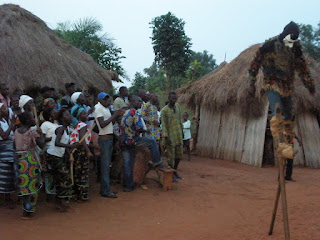
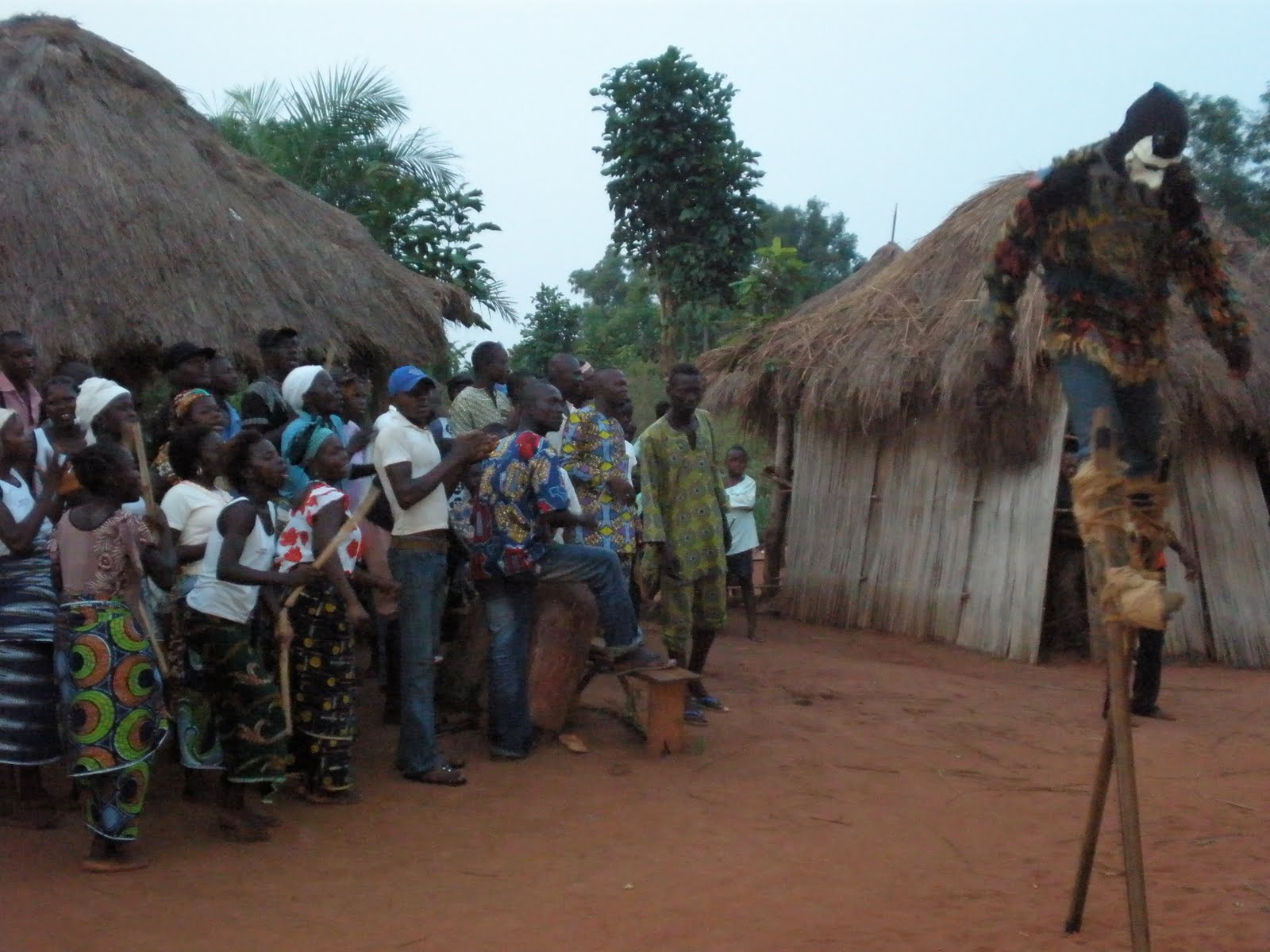
Agoh Ceremony
A few pictures and videos from a ceremony held in my village a few weeks ago. The costumed men dancing on stilts come out only, as far as I know, for a ceremony called Agoh. As I’ve written about in previous posts, funerals are a big occasion here and usually warrant several full days of food, drinks, drumming, and dancing. If a family is unable to afford a proper funeral at the time of death, they may wait awhile, till they “find” money as they say here, to celebrate their loved one’s life. With this particular ceremony I think the deceased had been gone for 10 years, the man who put it on had a decade worth of amends to make to someone!




Saturday, March 6, 2010
Tuesday, March 2, 2010
The heat is slowly killing me. If not actually taking my life, certainly robbing me of brain function. Figured I should write a blog before the damage is done.
It’s really unfortunate that Peace Corps volunteers don’t have regular access to social networking sites. If we could update our Facebook statuses or Tweet (feel like a tool just for using that word) on a regular basis like the rest of the iPhone- and Blackberry-toting world, it would be endlessly entertaining. Imagine a Peace Corps version of Texts from Last Night or F My Life. It’d be something like:
Spent all day trying to outrun the town crazy who has apparently made it his new and only objective in life to hug me.
Just sharfed in a field. Again.
Had to make an emergency drop trou manuver in [insert semi-public location].
Just realized my flour is swimming with maggots. AFTER I baked and devoured a batch of cookies.
While trying to ask where the toilet is in local language I accidentally said [insert something wildly inappropriate].
Found out the bracelet I bought at the market last month is actually a voodoo fertility charm.
Or anything that starts with
“So I’m in my latrine and…”
“So I’m eating what I think is chicken and…”
You get the point.
We already have a running list of “You Know You’re a PCV in Benin When…” but most of those are references that only those of us, uh, privileged enough to know Peace Corps Benin would get. I do think there should be some kind of Murphy’s Law for Peace Corps. Things like
-You will unintentionally flash every male in a 50m vicinity any time you attempt to mount your bike in African garb.
-The electricity WILL go out during the hottest part of the day when you need a fan the most.
-Insects will find even the tiniest holes in your mosquito net and eat you alive at night.
-The taxi you choose will a) brake down, b) attempt to break a Guinness World Record for number of goats and/or chickens in a passenger vehicle, c) load so much cargo on the top that either the back fender is constantly touching the road and creating sparks or the center of gravity is so high that you spend the entirety of your trip in constant fear of the car toppling and the family of 8 in the 2 seats next to you crushing you, d) all of the above.
Some volunteers do have regular access to internet, BTW. Whereas I’m about two hours from the nearest cyber so I usually just go every couple weeks, some volunteers have internet on their phones or wireless cards which allow you to get internet access anywhere you get phone reception. Apple computers, though superior to PCs in every other facet, are not compatible with these wireless cards, so even if I did want to get internet in my house, I could not. (WTF, Steve Jobs???)
Recent updates: I had a fever and the kind of all over sick feeling that begets this weekend so I was holed up in my house all Sunday. Went through all my college photos- relived Barcelona shot bars, tubing in Vang Vieng, a few too many Chi O events, and all the people and places that made up the last 4 years of my life. Seriously miss my friends, my closet, Coffee Bean vanilla tea lattes, Novel brunches, and Westwood sake specials. (Things I don't miss include LA traffic and the line at Maloney's, FYI.)
Saturday was a village clean up I’d helped organize. We chose 4 villages to clean up the last Saturday of every month. I was really excited and optimisitic about it up until the day before the clean up when my work partner at the mayor’s office and I did a tour to see what areas of the villages need to be cleaned up. It became apparent to me that he was only interested in pulling weeds and grasses, not in picking up what we Americans think of as trash. You can imagine that, since everything here is dirt road, grass and weeds are the norm. So Saturday 15 Beninese pulled weeds and carefully disposed of them about 10 feet from wherever they were pulled, while I trailed behind picking up plastic bags, wrappers, etc. which they then burned afterward without my knowledge. Pretty sure the plastic bags do more harm to your respiratory system burnt than they would do piling up on the side of the road, since apparently I’m the only one who sees it as an eyesore. It’s difficult to be an environment volunteer when your idea of the environment and theirs is almost completely opposite. Just visited the national forest 25km from Zè, which I expected to be, like in the US, a forest that is protected by the national government. Way off. It actually just means that it’s the government that pockets the money when the trees are cut down in that area. Good to know.
Just saw Kill Bill 2 for the first time and was highly unsettled by how shockingly unassuming a black mamba is. I was expecting an anaconda kinda thing- you KNOW when you see it. So my Larium dreams have a new star, which is good because I was starting to become immune to bats and cockroaches.
I often let neighborhood kids come in my house and just hang out. They don’t do much except play the voice message on my Build-A-Bear (“This is your grandma, and this is Kristen, and we love youuuu!) repeatedly and stare at me. But I find it less unsettling when they stare at my in my house than when they stand outside my screen door and stare. I feel like other people are going to see kids looking in and think there’s something to see and eventually a crowd will gather that I won’t be able to disperse. You think this sounds out there, I know it’s not. So one group of kids was here this weekend and when I finally got them to leave my house I realized one little girl had peed on my couch! The only person that has the right to lose their bowels on my furniture is me. Still pretty mad about it.
This is one of the hottest times of the year, before the rainy season starts up again at the end of this month. While I have no doubt that wouldI prefer this weather to other parts of the Peace Corps world where PCVs deal with below freezing temperatures, you should all still feel bad for me.
On a serious note, March 12 will be one year sine the death of Benin PCV Kate Puzey. There is a memorial in Cotonou that all the volunteers and American community in Benin will attend, and a separate memorial in Kate’s village along with a ceremony renaming the village’s primary school after her. Keep her family in your thoughts.
It’s really unfortunate that Peace Corps volunteers don’t have regular access to social networking sites. If we could update our Facebook statuses or Tweet (feel like a tool just for using that word) on a regular basis like the rest of the iPhone- and Blackberry-toting world, it would be endlessly entertaining. Imagine a Peace Corps version of Texts from Last Night or F My Life. It’d be something like:
Spent all day trying to outrun the town crazy who has apparently made it his new and only objective in life to hug me.
Just sharfed in a field. Again.
Had to make an emergency drop trou manuver in [insert semi-public location].
Just realized my flour is swimming with maggots. AFTER I baked and devoured a batch of cookies.
While trying to ask where the toilet is in local language I accidentally said [insert something wildly inappropriate].
Found out the bracelet I bought at the market last month is actually a voodoo fertility charm.
Or anything that starts with
“So I’m in my latrine and…”
“So I’m eating what I think is chicken and…”
You get the point.
We already have a running list of “You Know You’re a PCV in Benin When…” but most of those are references that only those of us, uh, privileged enough to know Peace Corps Benin would get. I do think there should be some kind of Murphy’s Law for Peace Corps. Things like
-You will unintentionally flash every male in a 50m vicinity any time you attempt to mount your bike in African garb.
-The electricity WILL go out during the hottest part of the day when you need a fan the most.
-Insects will find even the tiniest holes in your mosquito net and eat you alive at night.
-The taxi you choose will a) brake down, b) attempt to break a Guinness World Record for number of goats and/or chickens in a passenger vehicle, c) load so much cargo on the top that either the back fender is constantly touching the road and creating sparks or the center of gravity is so high that you spend the entirety of your trip in constant fear of the car toppling and the family of 8 in the 2 seats next to you crushing you, d) all of the above.
Some volunteers do have regular access to internet, BTW. Whereas I’m about two hours from the nearest cyber so I usually just go every couple weeks, some volunteers have internet on their phones or wireless cards which allow you to get internet access anywhere you get phone reception. Apple computers, though superior to PCs in every other facet, are not compatible with these wireless cards, so even if I did want to get internet in my house, I could not. (WTF, Steve Jobs???)
Recent updates: I had a fever and the kind of all over sick feeling that begets this weekend so I was holed up in my house all Sunday. Went through all my college photos- relived Barcelona shot bars, tubing in Vang Vieng, a few too many Chi O events, and all the people and places that made up the last 4 years of my life. Seriously miss my friends, my closet, Coffee Bean vanilla tea lattes, Novel brunches, and Westwood sake specials. (Things I don't miss include LA traffic and the line at Maloney's, FYI.)
Saturday was a village clean up I’d helped organize. We chose 4 villages to clean up the last Saturday of every month. I was really excited and optimisitic about it up until the day before the clean up when my work partner at the mayor’s office and I did a tour to see what areas of the villages need to be cleaned up. It became apparent to me that he was only interested in pulling weeds and grasses, not in picking up what we Americans think of as trash. You can imagine that, since everything here is dirt road, grass and weeds are the norm. So Saturday 15 Beninese pulled weeds and carefully disposed of them about 10 feet from wherever they were pulled, while I trailed behind picking up plastic bags, wrappers, etc. which they then burned afterward without my knowledge. Pretty sure the plastic bags do more harm to your respiratory system burnt than they would do piling up on the side of the road, since apparently I’m the only one who sees it as an eyesore. It’s difficult to be an environment volunteer when your idea of the environment and theirs is almost completely opposite. Just visited the national forest 25km from Zè, which I expected to be, like in the US, a forest that is protected by the national government. Way off. It actually just means that it’s the government that pockets the money when the trees are cut down in that area. Good to know.
Just saw Kill Bill 2 for the first time and was highly unsettled by how shockingly unassuming a black mamba is. I was expecting an anaconda kinda thing- you KNOW when you see it. So my Larium dreams have a new star, which is good because I was starting to become immune to bats and cockroaches.
I often let neighborhood kids come in my house and just hang out. They don’t do much except play the voice message on my Build-A-Bear (“This is your grandma, and this is Kristen, and we love youuuu!) repeatedly and stare at me. But I find it less unsettling when they stare at my in my house than when they stand outside my screen door and stare. I feel like other people are going to see kids looking in and think there’s something to see and eventually a crowd will gather that I won’t be able to disperse. You think this sounds out there, I know it’s not. So one group of kids was here this weekend and when I finally got them to leave my house I realized one little girl had peed on my couch! The only person that has the right to lose their bowels on my furniture is me. Still pretty mad about it.
This is one of the hottest times of the year, before the rainy season starts up again at the end of this month. While I have no doubt that wouldI prefer this weather to other parts of the Peace Corps world where PCVs deal with below freezing temperatures, you should all still feel bad for me.
On a serious note, March 12 will be one year sine the death of Benin PCV Kate Puzey. There is a memorial in Cotonou that all the volunteers and American community in Benin will attend, and a separate memorial in Kate’s village along with a ceremony renaming the village’s primary school after her. Keep her family in your thoughts.
Subscribe to:
Posts (Atom)

